Paris has a reputation for being expensive, and plenty of travelers assume a simple hotel room will blow their budget before they’ve seen a single museum. The truth is more reassuring: you don’t need to sleep in a dorm or commute in from the suburbs to afford the city. But most people planning a trip have no idea what a realistic nightly budget for a basic room actually looks like, so they either overpay out of caution or set expectations too low.
This guide breaks down what budget hotels in Paris really cost per night, and how that number shifts with the season, the arrondissement and your booking habits. You’ll find realistic price ranges for each scenario, plus what to expect from a cheap room and which alternatives — hostels, aparthotels, business hotels — can stretch your money further. By the end, you’ll be able to plan a Paris stay at a price you can actually predict.
What Budget Hotels in Paris Actually Cost Per Night
For a basic double room in a 2-star or simple 3-star hotel, expect to pay €70–€120 per night. That’s the realistic baseline for most of the city, and it covers clean, comfortable rooms in buildings that won’t win design awards but will give you a proper bed, a private bathroom and a decent night’s sleep. Hotels at the lower end of that range tend to sit in outer arrondissements or on quieter streets; those near the top usually have a better location or fresher rooms.
If you’re traveling alone and don’t mind simplifying, single rooms and rooms with shared bathrooms can drop to €55–€80 in quieter months. Shared bathrooms are far more common in Paris than in many other European capitals, especially in older, family-run hotels, and for a short city break they’re often a fair trade for the savings.
What higher prices actually mean
Don’t assume that anything above your target price is out of reach or overpriced. Rates above €130 usually signal a better location or a recent renovation rather than true luxury — a freshly refurbished 3-star near a major Metro hub, for example. In those cases it can be worth stretching the budget slightly, since you’ll save time and Metro fares during your stay.
The key is knowing what you’re paying for. A €135 room with a renovated bathroom and a two-minute walk to a Metro line is a different purchase from a €135 room that’s simply riding a busy weekend. Check recent photos and reviews, and compare what the extra money buys before you dismiss a hotel as too expensive.
How the Season Changes Your Nightly Rate
Timing matters almost as much as location when it comes to Paris hotel prices. The same room can swing by €40 or more between high season and low season, so knowing the calendar is one of the easiest ways to cut your costs without changing anything else about your trip.
June through August and the Christmas–New Year stretch are the most expensive times to visit, with rates of €110–€150 for budget rooms. Summer brings the biggest crowds, and the holidays combine tourists with people visiting family, so hotels have no trouble filling rooms at higher prices. On the other end, November through March — outside the holidays — is the cheapest window, with many rooms at €60–€90. If your dates are flexible, this is when Paris costs the least.
Shoulder months like April–May and September–October sit in the middle at roughly €85–€115. Many travelers consider this the sweet spot: you pay noticeably less than in peak season while enjoying milder weather and longer daylight than in deep winter.
- Book early for June and September. These months combine good weather with events and conferences, so the cheapest budget rooms in central areas often sell out weeks before cheaper months do.
- Watch the gap around Christmas markets and New Year’s Eve. The days just before and after December 31st can cost more than the holidays themselves, as visitors time their trips around the celebrations.
- Use low season for longer stays. Since winter rates run €60–€90, an extra night in February costs about the same as a single peak-season night in July — a smart way to see more of the city for the same money.
Where You Stay: Arrondissement Price Differences
Paris is divided into 20 arrondissements that spiral outward from the center like a snail shell, and your nightly rate follows that spiral closely. Hotels in the central arrondissements (1st–9th) — the ones covering the Louvre, Notre-Dame, the Marais and the area around the Eiffel Tower’s side of the river — charge noticeably more per night than outer ones for comparable rooms. Two hotels with nearly identical rooms can sit just a few Metro stops apart and land in completely different price brackets.
That premium buys walkability, not necessarily comfort. A room near the Panthéon and a cheaper room in the 11th can be nearly identical inside; you’re mostly paying for the address. For budget travelers, deciding how much that address is worth is one of the biggest cost decisions of the whole trip.
The best value arrondissements
The 10th, 11th, 12th, 18th and 19th offer the best price-to-location balance. These neighborhoods have plenty of cafés, markets and local life, sit directly on Metro lines, and keep you within roughly 15–25 minutes of the main sights. The 18th around Montmartre is touristy on the hill itself but much calmer and cheaper on its edges.
If you’re curious how the city’s grand boulevards and neighborhoods fit together geographically, there’s a helpful overview of Paris boulevards and the districts beyond them that puts the arrondissement system in context.
The Metro trade-off
Staying near a Metro line a few kilometers from the center can shave a meaningful chunk off each night. Over a five-night stay, that adds up to real money — often enough to cover several museum entries or a nice dinner. The trade-off is a Metro ride of roughly 10–20 minutes to reach the center, which most travelers find perfectly acceptable when the savings are this clear.
When and How to Book for the Best Price
Once you’ve picked a neighborhood, when you book shapes what you pay just as much as where you stay. The same hotel can charge noticeably different rates for the identical room depending on how far ahead you reserve and which nights of the week you choose. A little planning goes a long way here, and none of it requires special tools or insider contacts. These four habits are the ones that consistently make a difference for budget travelers.
- Book two to three months ahead. This is the sweet spot for budget hotels in Paris. Rates booked at that distance typically come in 15–25% lower than last-minute prices for the same room. Waiting until the week of your trip rarely pays off, especially in popular months when availability shrinks and the remaining rooms are the pricier ones.
- Shift your stay to Sunday through Thursday. Weekend nights carry a surcharge that can meaningfully raise your nightly average. If your schedule is flexible, centering your trip on midweek nights keeps costs down without changing anything else about your hotel.
- Compare the free-cancellation rate before dismissing it. It costs slightly more than the non-refundable price, but if your dates might shift — or you’re waiting on cheap flights — the small premium is usually worth it. A cheap non-refundable rate only works if you’re certain you’ll travel.
- Recheck your booking before you arrive. Prices for your exact room can drop after you’ve reserved. If your rate is flexible, canceling and rebooking at the lower price is a simple way to shave a few euros off the total.
None of these steps takes more than a few minutes, and together they can easily save you the cost of an extra night over a weeklong stay. Combine early booking with midweek dates and flexible rates, and you’ll consistently land at the lower end of what your chosen hotel charges — often without compromising on location or comfort.
What to Expect From a Cheap Paris Hotel Room
Parisian budget hotels are honest about what they are: small rooms in older buildings, priced for location rather than space. If you arrive expecting a US-style room, the reality can feel like a shock. Knowing what’s normal helps you pick well instead of being disappointed on arrival.
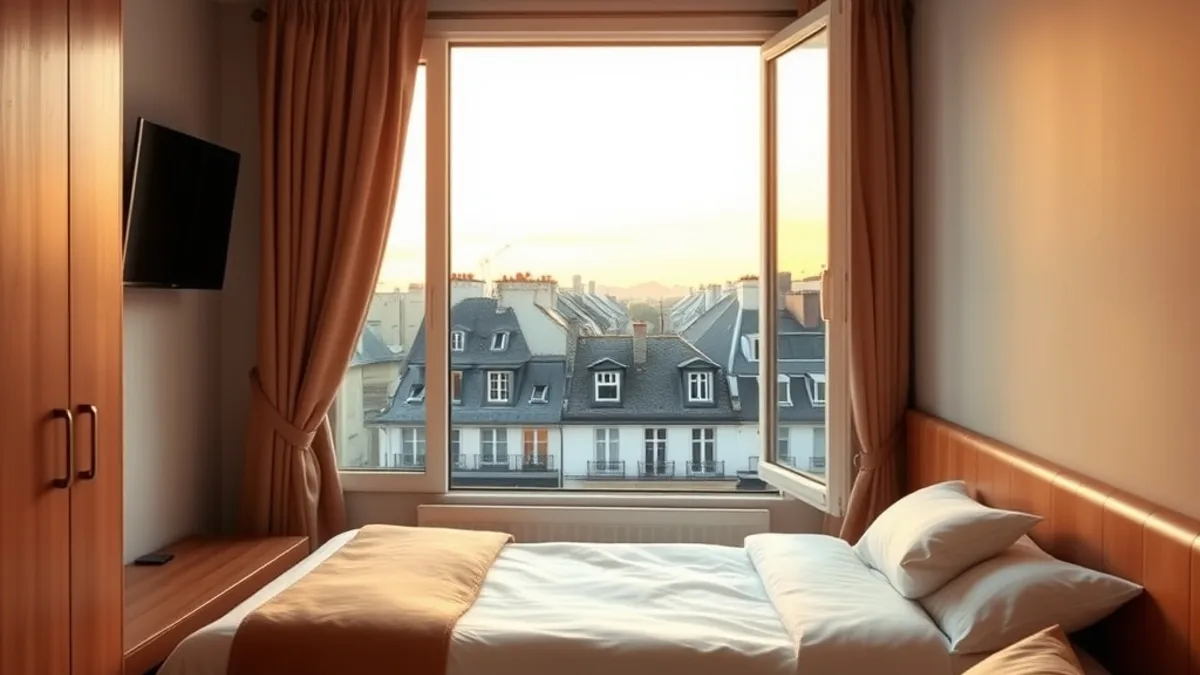
Most budget rooms here measure just 12–16 m², noticeably smaller than what American or Asian travelers may be used to. That’s enough space for a double bed, a small desk or shelf, and a walkway around the luggage you leave open. The bathroom is often equally compact, sometimes with a shower over the tub squeezed into a corner.
- Check for an elevator before booking. Many budget hotels occupy classic Haussmann-era buildings where the stairwell spirals up six or seven floors. Listings usually mention “no lift” — take it seriously if you have heavy bags or knee problems, and ask for a lower floor when you reserve.
- Read recent reviews about noise and walls. Thin walls are common in older buildings, and rooms facing the street can pick up café and traffic noise late into the evening. Reviews often name the quietest rooms, which you can then request directly.
- Do the breakfast math before adding it. Hotel breakfast, when offered, usually adds €8–€12 per person per day. A café around the corner typically serves a coffee and a croissant or tartine for less, so skipping the hotel option saves money without sacrificing anything.
- Look at the photos of the bathroom, not just the bedroom. Some budget rooms have showers only, no tub, or a sink in the sleeping area. If that bothers you, filter listings accordingly rather than discovering it at check-in.
None of these quirks should scare you off — compact rooms are exactly how budget hotels keep their rates low in a space-starved city. Pack a lighter suitcase, check the details before booking, and a small room becomes a non-issue rather than a daily frustration.
Alternatives That Stretch Your Paris Budget Further
Hotels aren’t the only way to sleep cheaply in Paris, and depending on your trip, one of these alternatives may beat a budget hotel on both price and comfort. They work especially well for longer stays or for travelers who don’t need a traditional hotel setup. Here are the three options worth comparing before you book.
Hostel private rooms
Forget the shared-dorm stereotype for a moment: many Paris hostels offer private rooms with en-suite or private bathrooms, and these often undercut budget hotels in the same neighborhoods by a noticeable margin. You get a simpler room, but usually a lively common area, a bar or kitchen, and staff who deal with travelers all day. For solo travelers and couples on a tight budget, it’s often the best value in the city.
Aparthotels and business hotels
Aparthotels give you a small studio with a kitchenette — a cooktop, a sink, a fridge, and basic cookware. On stays of four nights or more, being able to prepare breakfast and a simple dinner each day cuts your food spending dramatically, which matters more than the room rate itself over a week.
Business hotels near the Périphérique, the ring road around the city, are another quiet bargain. They’re built for corporate guests, so rooms are functional and clean, and outside conference season their rates can dip well below what comparable central hotels charge. The trade-off is location: check that your hotel sits near a Metro or tram stop before booking, since a cheap room with an awkward commute eats up time and transit fares.
Whichever route you pick, compare the total cost of your stay — room plus breakfast plus transport — rather than the headline nightly rate. That’s where these alternatives quietly outperform traditional budget hotels.
Planning Your Paris Stay at the Right Price
So, how much do budget hotels cost in Paris per night? A realistic baseline is €70–€120 for a basic double room, and you can spend less than that if you travel in the November–March low season, when many rooms drop to €60–€90. Paris has a pricey reputation, but a simple, clean hotel room is genuinely within reach of a modest budget.
The two biggest levers are location and timing. Choosing an outer arrondissement instead of the central ones saves you €20–€40 per night, and booking 2–3 months ahead typically trims another 15–25% off the rate. Combine those two habits and your costs stay firmly in budget range, leaving more of your money for cafés, museums and long walks along the Seine. If this helped you plan your trip, leave a comment or share the article with a fellow traveler.